How to Choose the Best Beauty Products for a Successful Shopping Trip?
The cosmetics market is making more and more claims on its packaging, while the regulations governing them continue to evolve. Since October 2023, the European REACH restriction has banned certain plastic microbeads added to cosmetic products, with a phased timetable running through 2035 for makeup and lip products.
In France, the law of June 9, 2023 requires influencers to clearly disclose the commercial intent behind their beauty recommendations. Together, these two frameworks change what shoppers can reasonably verify before making a purchase.
“Natural” and “microplastic-free” claims on cosmetics: what they really cover
A bottle labeled “natural” does not guarantee that its formula is free of synthetic polymers. A standard for calculating naturalness measures the proportion of ingredients of natural origin, but it is not an environmental label and does not certify that the product is free of microplastics.
This distinction matters because the REACH timetable is being introduced in stages. Intentionally added exfoliating microbeads are already banned. Rinse-off products (shower gels, shampoos) will follow in 2027, most leave-on products in 2029, and then makeup, lip and nail products in 2035. A “plastic-free” claim does not say which deadline it refers to.
Before buying, checking the INCI list is more reliable than relying on a marketing term. Synthetic polymers appear there under names such as “acrylates copolymer” or “polyethylene.” If you’re unfamiliar with INCI lists, apps such as INCI Beauty let you scan a barcode and get an ingredient-by-ingredient analysis.
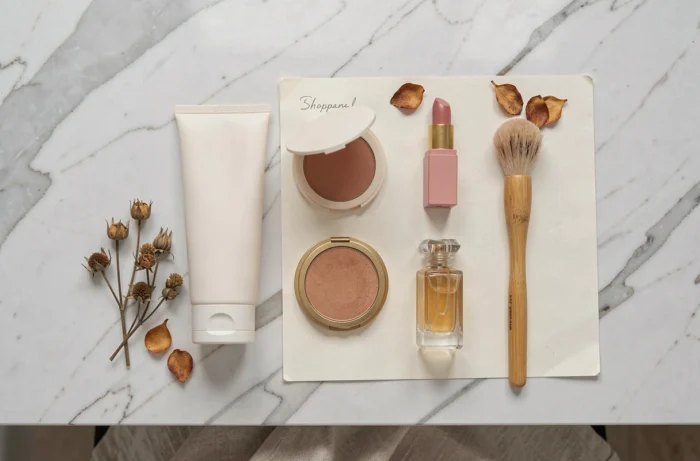
To explore product selections already filtered by composition, Pop Your Beauty’s shopping section brings together products whose listings detail their active ingredients and formulas.
Independent beauty advice or sponsored recommendation: how to tell the difference
The law of June 9, 2023 requires commercial intent to be clearly disclosed when it is not already apparent from the context. In practice, labels such as “advertising,” “commercial collaboration” or “paid partnership” must be clearly visible. In principle, content without any of these disclosures is an independent editorial opinion.
The problem lies in the gray area. Some creators receive free products without a formal contract, or earn commissions through affiliate links without always disclosing this. The absence of a legal disclosure does not prove that the advice is independent.
Three practical pointers can help you assess whether a recommendation is reliable:
- Check whether the post includes a partnership disclosure, even if it is subtle (often at the very beginning or end of the content, sometimes in a hashtag).
- Compare it with other sources: a product recommended by just one creator and missing from independent comparisons deserves closer scrutiny of its ingredients.
- Be wary of content that presents a cosmetic as a substitute for a treatment or medical procedure, because the law specifically regulates the promotion of non-therapeutic aesthetic methods presented as alternatives to treatments.
Check the INCI list before buying: habits that can change the way you shop for beauty products
The INCI list (International Nomenclature of Cosmetic Ingredients) is required on all cosmetic packaging sold in Europe. Ingredients are listed in descending order of concentration. This is the most useful information available to shoppers who are not specialists.
If an active ingredient highlighted on the packaging appears near the end of the list, its concentration is probably negligible. Hyaluronic acid or vitamin C listed after fragrances and preservatives make up only a tiny fraction of the formula. Marketing highlights the active ingredient; the INCI list reveals its actual place in the formula.
The total number of ingredients is also a useful indicator. A short formula (fewer than about 15 ingredients) is easier to assess and statistically limits the risk of allergens. By contrast, a list of 30 ingredients or more makes it harder to track what you’re applying to your skin.
Allergens and ingredients to watch out for
European regulations require fragrance allergens to be listed individually above a certain threshold. They appear near the end of the INCI list under names such as “linalool,” “limonene” or “citronellol.” They are not banned, but having a large number of them in a single product increases the risk of a reaction for sensitive skin.
For ingredients considered problematic (certain UV filters, preservatives such as phenoxyethanol), their position on the list and the product category (rinse-off or leave-on, frequency of application) affect actual exposure levels.

Beauty products and skin type: why a skin assessment should come before shopping
Buying skincare without knowing your skin type is like choosing a shoe size at random. The four main categories (oily, dry, combination, normal) are not always enough. Sensitivity, acne-prone skin and dehydration are conditions that can overlap with your underlying skin type and affect your choice of textures and active ingredients.
An assessment at a pharmacy or beauty salon is still the most reliable way to guide your first purchases. Online tools offered by some brands can be helpful, but they naturally lead to recommendations from their own product range.
Once you know your skin type, it’s best to keep your routine short. Using more products increases the risk of interactions between active ingredients (an acid exfoliant combined with retinol, for example) and adds to your budget without delivering a proportional benefit for your skin.
- Oily skin: choose lightweight textures (gel, fluid) and sebum-regulating ingredients such as niacinamide or zinc.
- Dry skin: look for formulas rich in fatty acids (shea butter, argan oil) and occlusive agents that help limit water loss.
- Sensitive or reactive skin: reduce the number of ingredients and avoid fragrances, even those of natural origin, which are among the most commonly declared allergens.
European regulations and France’s 2023 law provide practical tools for checking what a product or influencer promises. The most useful habit is to turn the packaging around before looking at the price tag: the INCI list and legal disclosures tell you more about a cosmetic than its packaging does.