
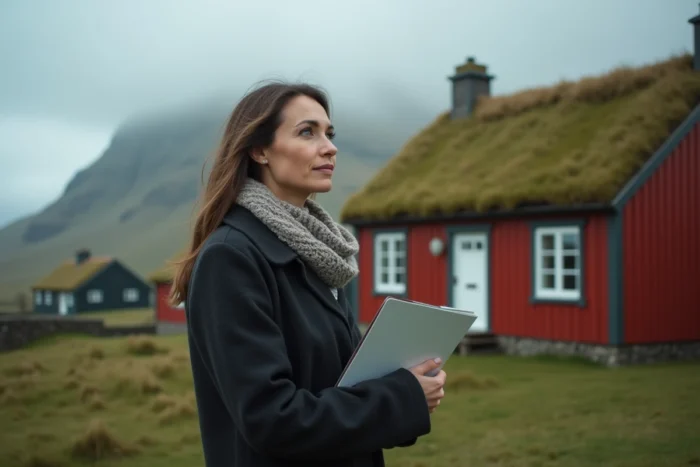
Buying a House in the Faroe Islands: A Practical Guide for Foreigners
The Faroe Islands attract with their volcanic landscapes and colorful villages, but the real estate market of the archipelago remains unknown to foreign buyers. Between a housing shortage, legal framework linked to Denmark, and very different realities depending on whether one is targeting Tórshavn or an isolated village, the parameters to evaluate before diving in far exceed the budget question.
Tórshavn or isolated village: two real estate realities in the Faroe Islands
The Faroese market does not operate as a unified market. The capital concentrates the majority of demand, jobs, and services, creating pressure on prices and a limited supply. Outside of Tórshavn, single-family homes remain more accessible, but practical constraints change radically.
| Criteria | Tórshavn | Village (outside the capital) |
|---|---|---|
| Availability | Very low, severe shortage | More single-family homes available |
| Price | Significantly higher, recent increase | More moderate, but variable |
| Services (health, schools) | Full access | Limited, sometimes absent |
| Transport | Local network, ferries, tunnels | Weather-dependent, irregular connections |
| Social integration | More diverse community | Stronger social pressure, close-knit neighborhood |
Feedback from expatriates living outside the capital confirms a often underestimated point: the weather conditions daily movements in the villages. A ferry canceled due to strong winds can block access to health services or school for several days.
Anyone wishing to buy a house in the Faroe Islands must first resolve this geographical question, as it determines the lifestyle much more than the budget.
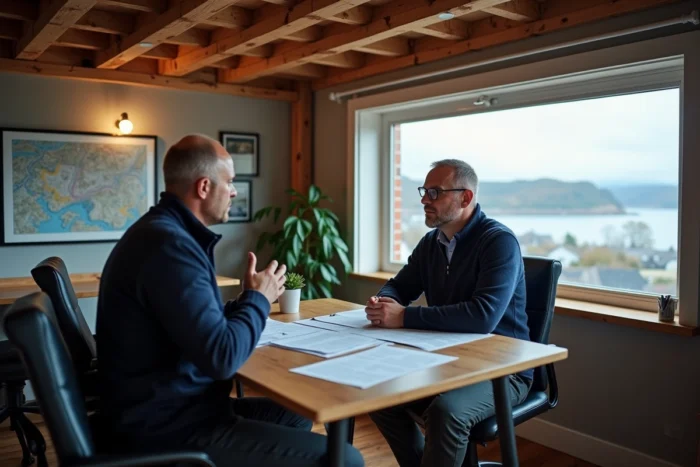
Legal restrictions for foreign buyers in the Faroe Islands
The Faroe Islands are part of the Kingdom of Denmark but have a wide legislative autonomy. The real estate legal framework is not the same as that applicable in Copenhagen or Jutland.
A non-resident foreigner must obtain a specific authorization to acquire real estate in the archipelago. This requirement aims to protect a restricted land market in an area where the habitable area is limited by volcanic geography.
Points of caution before any steps
- Permanent residency in the Faroe Islands facilitates the purchasing process but does not make it automatic. A local employment contract or a professional connection to the archipelago is an asset for obtaining authorization.
- The Faroese authorities have been seeking since the early 2020s to attract qualified foreign professionals in priority sectors (health, technology, engineering). A sought-after professional profile can accelerate access to housing in certain areas.
- The notary and local real estate intermediaries operate in Faroese or Danish. Contractual documents are not systematically translated into English, which necessitates the use of a sworn translator.
Unlike other Nordic territories, the Faroe Islands are not members of the European Union. European nationals do not benefit from the free movement of capital for real estate.
Housing shortage and construction delays in the Faroe Islands
Since 2023-2024, several Danish and Faroese analyses document a severe housing shortage in the archipelago, particularly in Tórshavn. Construction delays have increased, and prices have seen a marked rise.
This pressure does not only affect foreigners. Buying remains very difficult even for Faroese residents, which mechanically limits the number of properties available on the resale market. New constructions struggle to keep up with demand, partly due to the logistics of transporting materials to an isolated archipelago in the North Atlantic.
Undersea tunnels and new attractive areas
The opening of new undersea tunnels between the islands is gradually changing the map of interesting locations. Villages that were once isolated are becoming more accessible, which could rebalance the pressure on Tórshavn in the medium term.
For a foreign buyer, these infrastructures change the calculation: a house in a village connected by tunnel offers a compromise between moderate price and access to the capital’s services. In contrast, islands accessible only by ferry or helicopter remain subject to weather-related uncertainties.

Faroese demographic policy and housing incentives
The authorities of the archipelago face a structural challenge: to curb the exodus of young people to mainland Denmark and attract new residents. Since the early 2020s, measures combining taxation, employment, and housing have been implemented.
These measures do not specifically target foreign real estate buyers, but they create a more favorable environment for those settling with a professional project. The sectors under pressure (health, IT, maritime engineering) open doors that financial capacity alone cannot cross.
The Faroese social fabric remains very tight-knit. In the villages, integration comes through participation in community life. Expatriates who share their experiences mention stronger social pressure than in urban settings, but also concrete solidarity once the first bonds are formed.
Financing and property taxation in the Faroe Islands
The Faroese banking system is distinct from the Danish system. Access to local mortgage credit for a non-resident remains limited, and Faroese banks generally require established residency and employment on-site before considering a loan application.
A foreign buyer who does not yet reside in the archipelago will most often need to finance the acquisition from their own funds or through a bank in their home country, with the guarantee constraints that this implies for a property located outside the eurozone.
The local property taxation differs from the standard Danish regime. Property taxes remain moderate compared to major Scandinavian cities, but the maintenance costs of a house exposed to the North Atlantic climate (wind, saline humidity, logistical isolation for repairs) represent a budget item not to be underestimated.
The Faroese real estate market remains a niche market, without a centralized listing portal comparable to what exists in Denmark or Norway. Transactions often occur through local word-of-mouth or through a few agencies based in Tórshavn. A foreign buyer approaching this market without local contacts starts at a real disadvantage, which only a prolonged stay or a trusted intermediary can compensate for.