
Everything You Need to Know to Choose the Right Professional Equipment: Tips and Tricks
The professional equipment market covers a wide spectrum, from construction tools to computer workstations, including personal protective equipment. Offers are multiplying, ranges are segmenting, and regulatory obligations are evolving. Choosing professional equipment involves going beyond simple price comparisons to include less visible criteria: repairability, long-term compliance, compatibility with existing equipment.
Repairability and spare parts: the criterion that catalogs do not highlight
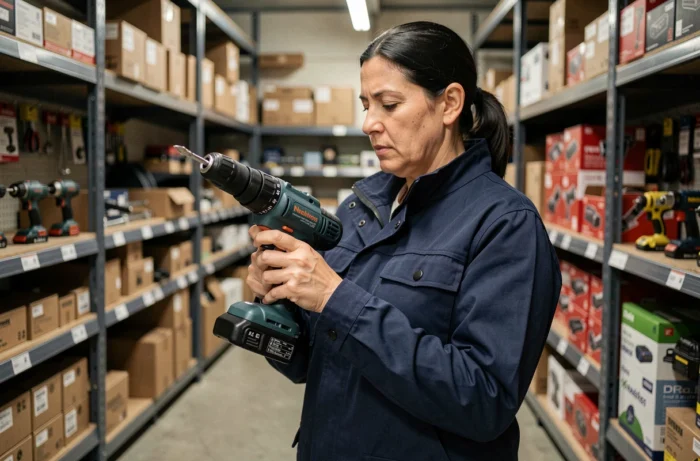
The actual lifespan of professional equipment is not measured by its commercial warranty. It mainly depends on the concrete possibility of repairing it when a component fails. For several categories of equipment (laptops, phones, certain powered tools, gardening equipment), manufacturers must make spare parts available for at least five years from the market launch of the last unit of the model.
This regulatory timeframe serves as an objective selection filter. Two pieces of equipment with comparable performance on paper can diverge radically on this point. A manufacturer that stops producing spare parts after two or three years forces you to buy a whole new unit, even if the rest of the machine is still functioning.
Before any purchase, check with the supplier for the actual availability of consumables and replacement components. You can also explore equipment on Habiz to compare ranges on this rarely displayed criterion.
Personal protective equipment: mandatory follow-up after purchase
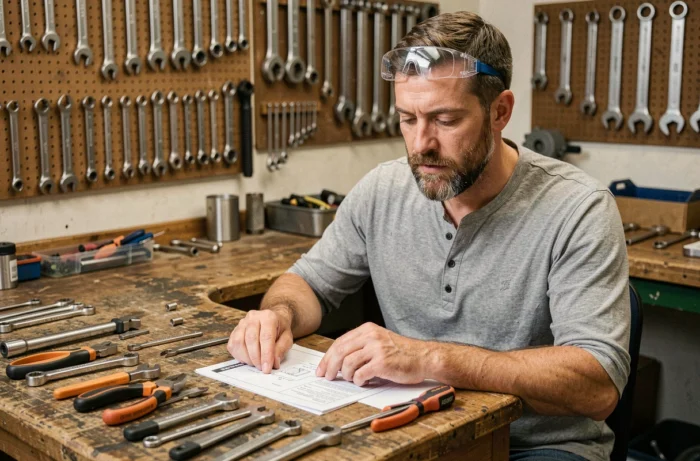
PPE (helmet, gloves, back support, boots, protective jacket) is not a one-time purchase. Employers must provide suitable equipment for risks and workers free of charge, then ensure their maintenance, repairs, replacements, and periodic checks. This is an obligation, not a recommendation.
An initially compliant PPE can become unsuitable if its condition deteriorates, if its performance decreases, or if its expiration date has passed. A hard hat that has been subjected to an impact loses its absorption properties, even without visible cracks. Chemical protection gloves whose elastomer has aged no longer filter anything.
Ongoing monitoring involves keeping a register of equipment, service dates, and a control schedule. Field feedback varies on the ideal replacement frequency depending on the profession, but the principle remains constant: buying PPE without organizing its follow-up is equivalent to not providing it.
- Check the manufacturing date and the lifespan indicated by the manufacturer, not just the purchase date.
- Create a register for each employee with the reference of each piece of equipment, its service date, and the next control deadline.
- Plan a buffer stock to immediately replace faulty equipment without interrupting operations.
Reuse and internal equipment exchange: an approach that changes the calculation
The classic reflex when facing a need for equipment is to look for the best value for money on new items. Some organizations have shifted the focus. The Post Office, for example, has developed an internal equipment exchange that allows for the reassignment of equipment between entities, combined with preventive maintenance and repairs before re-commissioning.
This logic transforms the question. Instead of “which model to buy,” the question becomes “does this equipment already exist somewhere in the organization, in a condition that allows for its reuse.” For a multi-site company or a franchise network, internal reuse reduces costs without sacrificing performance if maintenance is rigorous.
The available data does not allow for precise quantification of the savings achievable for each sector. However, the principle is clear: well-maintained and reassigned equipment costs less than a new purchase, and its environmental footprint decreases significantly.

When reuse reaches its limits
Reuse only works if the reassigned equipment remains compliant with current standards and suitable for the target workstation. A worn protective jacket, safety shoes with compressed soles, a power tool with weakened insulation: these items are not candidates for reuse, even if they still seem functional.
The boundary between smart savings and risk lies in traceability. Without a maintenance history or technical inspection before reassignment, reuse becomes a gamble.
Compatibility with existing equipment: the trap of isolated purchases
Professional equipment rarely operates alone. A power tool depends on its batteries and charger, a computer workstation integrates into a network, and a protective jacket must be compatible with the helmet and back support worn simultaneously.
Buying a high-performing model but incompatible with the existing fleet incurs additional costs for accessories, training, and adaptation time. Field feedback shows that compatibility with equipment already in service weighs as much as the intrinsic characteristics of the new equipment.
- For battery-powered tools, prioritize a system of interchangeable batteries within the same brand or ecosystem.
- For PPE, ensure that each element (helmet, hearing protection, goggles, back support) can be worn simultaneously without discomfort or loss of protection.
- For computer equipment, confirm software and network compatibility before finalizing the order.
The purchase of professional equipment benefits from being treated as a trade-off between several simultaneous constraints: immediate performance, actual maintenance duration, long-term regulatory compliance, and integration into an existing fleet. The purchase price represents only a fraction of the total cost of ownership. Companies that formalize these criteria before consulting catalogs avoid premature replacements and costly non-compliance.