
Handmade Jewelry: How to Enhance Your Style with Unique and Trendy Creations
Handmade jewelry occupies a segment where the boundary between adornment, symbolic object, and marketing promise blurs. Understanding the manufacturing techniques, materials, and valuation mechanisms allows for informed choices, far from the standardized storytelling that most brands recycle.
Handmade manufacturing techniques and real quality criteria
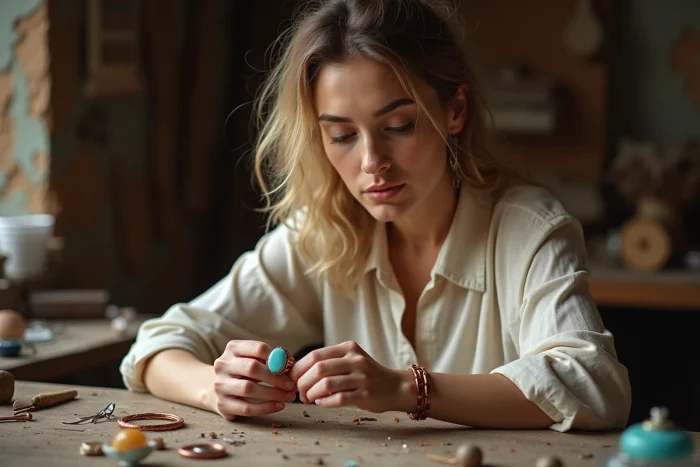
A handmade piece of jewelry is distinguished from industrial production by the number of manual interventions in the manufacturing chain. Welding, setting, polishing, patina: each step performed by hand introduces micro-variations that constitute the signature of the piece.
We observe that the term “handmade” encompasses very different realities. An artisan who melts their metal, shapes their setting, and sets their stone works at a technical level unrelated to an assembly of pre-fabricated components bought in bulk. This distinction matters when evaluating durability and resale value.
The creations offered by By Julie illustrate this approach where manual work is involved at every stage, from material selection to finishing.
Claw or closed settings remain the marker of true craftsmanship. A glued setting (stone simply glued onto a base) does not withstand the shocks of daily life. Checking the type of setting before purchase avoids disappointments after a few months of wear.
- The claw setting holds the stone with bent metal prongs, allowing light to pass under the gem to maximize brilliance
- The closed setting wraps the edge of the stone in a band of metal, offering superior protection suitable for rings worn daily
- The pavé setting, used for small aligned stones, requires precision on the order of a tenth of a millimeter and immediately reveals the artisan’s skill level
Materials of handmade jewelry: natural stones, silver, and alloys
925 silver (sterling) is the most common metal base in handmade jewelry. Its grade (925 thousandths of pure silver) guarantees a compromise between malleability for handwork and durability in wear. Gold plating, often in gold filled, adds a layer of gold mechanically bonded to the base metal, much more resistant than a simple gold flash.
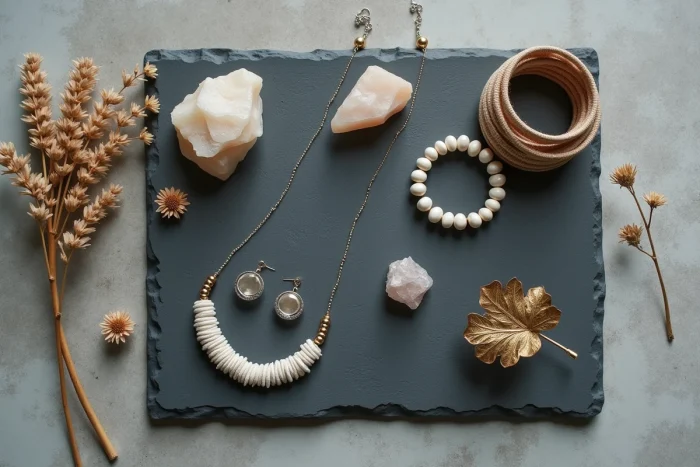
Each natural stone presents unique inclusions that make imitation impossible. Tiger’s eye, amethyst, agate, jade, or onyx do not behave the same way in setting: their hardness on the Mohs scale determines the applicable techniques and fragility in wear.
We recommend systematically asking for the exact type of stone and its origin. An artisan transparent about their materials will not hesitate to provide this information. The absence of a precise answer often indicates a supply of reconstructed stones sold as natural.
Alloys and surface treatments
Rhodium plating on silver protects against oxidation but wears off over time. Knowing that a piece of jewelry is rhodium-plated allows for anticipating periodic maintenance. Conversely, some artisans deliberately allow the silver to patina, considering this evolution as an integral part of the piece’s aesthetic.
Handmade jewelry as objects of ritual and personal identity
The market for handmade jewelry is evolving towards a dimension that goes beyond adornment. Some brands now position their creations as objects of personal ritual or well-being, associating symbolic properties with the stones used. This trend expands the use of jewelry beyond mere fashion accessories.
Personalization pushes this logic further. Engraving a date, choosing a stone linked to a birth month, a pattern carrying family significance: the jewelry becomes a marker of identity rather than just an ornament. Ultra-personalized symbolic gifts are gaining ground, with pieces where the meaning of the motif weighs as much as the design.
Limits of the commercial promise
This symbolic escalation raises an authenticity issue. Attributing well-being virtues to a natural stone is rooted in cultural tradition, not a verifiable fact. When commercial discourse transforms a belief into a sales argument, the line with misleading advertising draws closer.
A rigorous artisan presents the symbolic associations of stones for what they are: traditions, not therapeutic guarantees. This transparency distinguishes an honest approach from opportunistic marketing that instrumentalizes the quest for meaning.

Choosing handmade jewelry: the checks that matter
The traceability of materials remains the primary selection criterion. An artisan capable of naming their metal and stone suppliers offers a guarantee that opaque supply chains cannot provide.
- Check the hallmark on silver or gold pieces: its absence on jewelry sold as precious is a regulatory warning signal
- Ask if the jewelry is guaranteed against manufacturing defects, a sign that the artisan stands behind the quality of their work over time
- Observe the inner finishes of a ring or the back of a pendant: careful work on the invisible parts confirms an overall level of quality
- Favor creators who produce in small series or unique pieces, which reduces the risk of encountering semi-industrial items labeled as handmade
The price of handmade jewelry reflects the time of manual work, the cost of noble materials, and the margin necessary for the viability of a workshop. An abnormally low price for a piece presented as handmade and in solid silver deserves verification.
A well-crafted handmade piece of jewelry can be repaired, passed down, and ages with character. It is this functional durability, more than the emotional discourse, that justifies the investment compared to mass production that is disposable after a few seasons.