
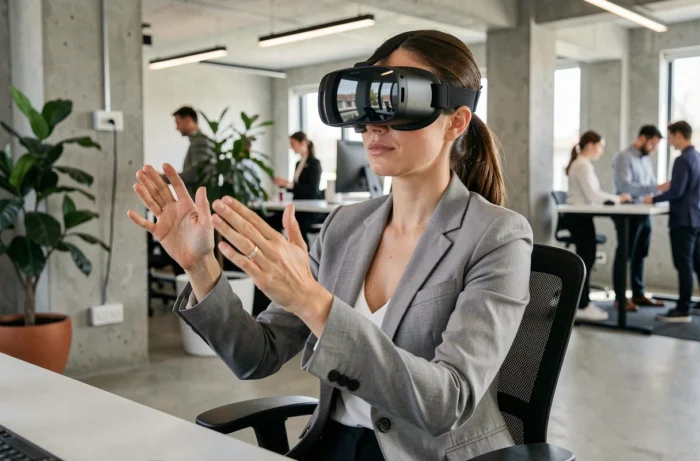
Immersive Virtual Reality Experience: Revolutionizing Learning and Training
A surgeon repeats a complex operation without a patient on the table. A maintenance technician works on a turbine without the risk of electric shock. In both cases, virtual reality headsets replace the classroom with an environment where the action is as important as the theory. Immersive training in virtual reality changes the way skills are developed, placing the learner in a nearly real situation before exposing them to the field.
Skill Transfer in VR: How Action-Based Memorization Changes Things
You may have noticed that a recipe read in a book is quickly forgotten, while a recipe cooked three times stays in memory? Immersive learning is based on this same principle. The learner retains better when they act in a simulated environment than when they listen to a lecture or read a document.
Virtual reality takes this logic further. It engages sight, hearing, and sometimes touch through the haptic feedback of controllers. The brain processes these stimuli as a lived experience, not as abstract information. This is why sectors with a strong gestural component (healthcare, industry, safety) prioritize adopting the technology.
Specialized platforms like immersivelab.fr design scenarios where each mistake triggers a visible consequence, prompting the learner to correct their action in real time. This right to make mistakes without danger is one of the most powerful pedagogical mechanisms of VR training.
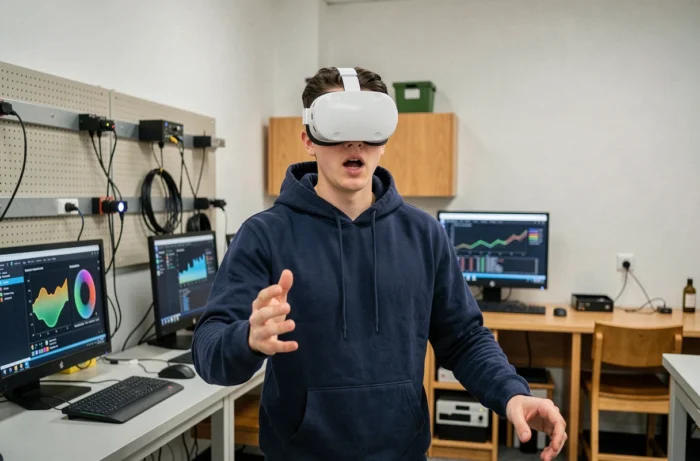
VR Pedagogical Scenario: Design That Makes a Difference
Simply putting a headset on an employee’s head is not enough to create effective training. The quality of the pedagogical scenario determines the outcome, not the equipment. A spectacular virtual environment that is poorly scripted produces wonder, not learning.
A good immersive scenario is based on three pillars:
- A precise learning objective, formulated before any 3D modeling (for example, being able to identify a gas leak in under two minutes)
- A step-by-step progression, where each stage validates a skill before moving on to the next, like in a flight simulator
- Immediate and contextualized feedback, explaining why an action is incorrect instead of just signaling the mistake
Why is this point so rarely addressed? Because technology attracts more attention than pedagogy. A meta-analysis published in 2025 in the journal Virtual Reality noted that sustainable skill transfer to the workplace remains an open question in many studies. Effectiveness measured in the lab does not guarantee that a learner will reproduce the correct action six months later in a real situation.
The Trap of Generic Scenarios
Some catalogs offer ready-to-use VR modules that are identical from one sector to another. A fire evacuation exercise designed for a logistics warehouse is not as relevant in a hospital. Adapting the scenario to the learner’s professional context determines the actual usefulness of the training.
Organizations that achieve the best results involve their internal trainers in the module design. The trainer knows the common mistakes in the field, the dangerous shortcuts, and the situations poorly covered by written procedures. This knowledge feeds into credible scenarios.
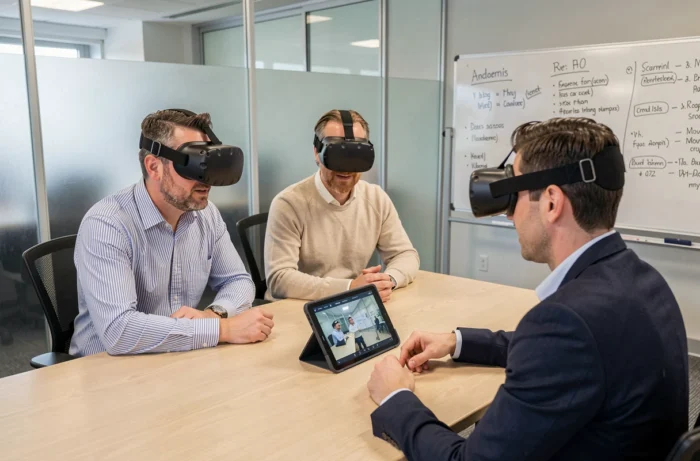
AI Regulation and Immersive Training: A Framework to Monitor
Are you using a VR module that analyzes a trainee’s facial expressions to assess their stress? Since February 2025, the European AI Act prohibits, except for medical or safety exceptions, AI systems that infer emotions in the workplace and in educational institutions.
This point directly concerns certain functions integrated into immersive training platforms. A VR headset equipped with sensors can measure gaze direction, pupil dilation, and heart rate. If an algorithm deduces an emotional state from this data to adapt the learning path or grade the learner, it potentially falls under this prohibition.
Personal Data and VR Pathways
Beyond emotional AI, the data collected during an immersive session is substantial: head movements, reaction times, observed areas, mistakes made. This information falls under GDPR as soon as it allows for the identification of an individual.
A training organization deploying VR must therefore clearly define:
- The purpose of each collected data (evaluation, scenario improvement, research)
- The retention period and the learner’s access rights to their own data
- The optional or mandatory nature of biometric tracking, with explicit consent
Ignoring these obligations exposes organizations to penalties and undermines learners’ trust in the system. Transparency regarding data usage is part of the immersive experience just as much as graphic quality.
Realistic Deployment of a VR Training Program in Companies
The most common mistake is launching a spectacular pilot project that does not survive the enthusiasm phase. Sustainable deployment requires pragmatic choices.
First, the equipment: standalone headsets (without a connected computer) have significantly simplified logistics. However, their graphical capacity limits the complexity of environments. For detailed industrial simulations, a fixed workstation may still be necessary.
On the content side, it’s better to start with one or two modules focused on critical skills (safety, technical actions that are costly in case of error) rather than trying to cover the entire training catalog. A well-calibrated VR module addressing a real need provides more value than ten generic modules.
Long-term maintenance is also a concern. A VR scenario must be updated when business procedures change, when equipment changes, or when regulations impose new steps. Planning a maintenance budget from the outset prevents outdated modules from ending up unused in a closet.
Immersive training in virtual reality does not replace the trainer; it provides them with a tool that text and video cannot match. Its effectiveness depends less on the headset worn than on the scenario constructed, the regulatory framework respected, and the willingness to measure what the learner truly retains once back at their post.