

How to Choose the Best Whisk for Making Perfect Homemade Mayonnaise
Mayonnaise is an oil-in-water emulsion whose success directly depends on the mechanical shear applied by the whisk. The choice of utensil determines the size of the oil droplets dispersed in the aqueous phase, and consequently the stability, texture, and shine of the sauce. An unsuitable whisk does not produce a “medium” mayonnaise: it simply prevents the emulsion from forming.
Number of wires and spacing: the parameters that dictate the fineness of the emulsion
We recommend looking at a mayonnaise whisk from the perspective of shear, not its overall shape. The determining parameter is the combination of the number of wires and their spacing. Each wire that passes through the mixture with each rotation cuts the oil droplets into smaller fractions.
A whisk with closely spaced wires multiplies the shear points with each pass. The result: finer droplets, a more stable emulsion, a firmer texture. Conversely, a whisk with widely spaced wires allows oil to pass without fragmenting it sufficiently, resulting in an unstable mixture that separates at the slightest excess of oil.
To quickly identify the best whisk for mayonnaise, we observe that the winning combination includes a minimum of eight flexible wires with regular and tight spacing. The flexibility of the wires is as important as their number: wires that are too rigid bounce off the mass instead of penetrating it.
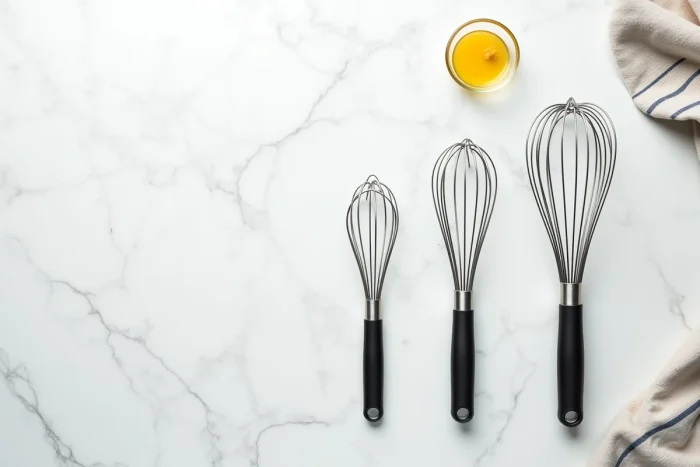
Balloon whisk vs. straight whisk for mayonnaise: two distinct mechanical logics
The balloon whisk, with its bulging shape and curved wires, incorporates air into the preparation. This is an advantage for whipped cream, but a parameter to master for mayonnaise. Too much air incorporated lightens the texture at the expense of stability. The mayonnaise becomes frothy rather than creamy, and its stability over time decreases.
The straight whisk (or sauce whisk, sometimes called French whisk) works more with horizontal shear. Its less curved wires stay in contact with the bottom of the container and fragment the oil with more precision. For a classic mayonnaise made with egg yolk and mustard, this is the most effective geometry.
In practice, a medium-sized balloon whisk works very well if the motion remains controlled: quick lateral movements rather than wide rotations. The straight whisk is more forgiving of motion approximations, making it a better choice for cooks who occasionally whip up their mayonnaise.
Spring whisk and mini-whisk: why they fail on an emulsion
Spiral spring whisks and mini bar whisks are appealing due to their compactness. On a vinaigrette or hot chocolate, they fulfill their function. On mayonnaise, they almost systematically fail.
The reason is mechanical: a single coiled wire does not create enough shear points to fragment the oil at the necessary speed. The ratio between the amount of oil poured and the whisk’s ability to disperse it is unbalanced. The emulsion does not form, or it breaks as soon as the oil flow increases slightly.
- The spiral spring whisk has only one continuous wire, which divides the oil droplets too slowly to stabilize the emulsion.
- Mini bar whisks rarely measure more than fifteen centimeters and do not cover enough surface in the bowl to effectively work a standard volume of mayonnaise.
- Flat roux whisks, designed to scrape the bottom of a pot, work by pushing rather than shearing, making them unsuitable for cold emulsions.
Whisk material and impact on homemade mayonnaise
Stainless steel remains the reference material for a mayonnaise whisk. It does not react to vinegar or lemon, does not retain fats, and is fully washable. A well-maintained stainless steel whisk imparts no off-flavors to the emulsion.
Silicone-coated whisks pose a often overlooked problem: the smooth surface of silicone reduces friction between the wires and the mixture. This friction contributes to shear. A silicone whisk protects non-stick containers, but it fragments the oil less effectively than a bare stainless steel wire.
For stainless steel or glass bowls (the two containers we recommend for mayonnaise), an all-stainless whisk without coating offers the best mechanical performance.
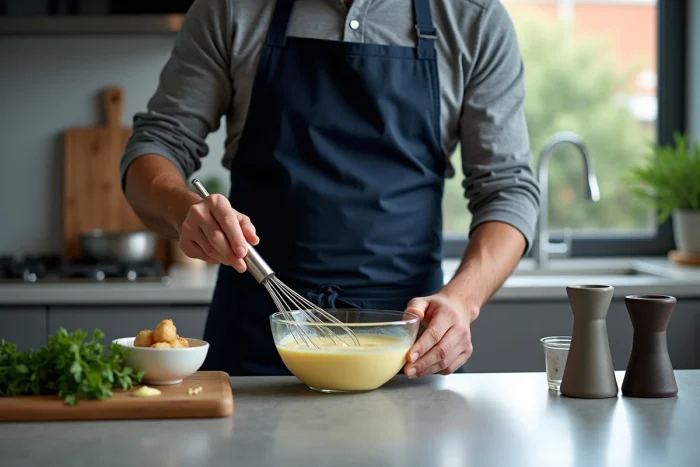
Manual whisk or immersion blender emulsifier attachment
Small appliance manufacturers now offer specific “emulsifying whisk” attachments for mayonnaise on immersion blenders. These stainless steel accessories are designed for emulsions and not just mixing, with shapes designed to limit the formation of overly coarse bubbles.
User feedback from robots like Monsieur Cuisine confirms that the whisk attachment truly changes the texture of the mayonnaise, making it lighter and firmer than with just the blade. The mayonnaise thickens more quickly and separates less with the whisk.
The manual whisk retains a decisive advantage: control over the oil flow. With an electric mixer or robot, the shear speed is high but constant. The manual whisk allows for adjusting the pace to the behavior of the emulsion in real-time, reducing the risk of a separated mayonnaise.
- The manual whisk is suitable for classic mayonnaises in small quantities, where control over the motion is paramount.
- The immersion blender emulsifier attachment is better suited for large volumes or eggless mayonnaises, which are more difficult to stabilize by hand.
- The robot with whisk attachment offers a good compromise for cooks who regularly whip up emulsified sauces.
For enhanced mayonnaises (with herbs, garlic), chefs like Jean Sulpice recommend infusing the oil beforehand and then whipping the mayonnaise with this flavored oil, rather than adding the flavorings at the end of preparation. The manual whisk is particularly well-suited to this technique, as it allows for dosing the incorporation of the flavored oil drop by drop.
The choice of whisk for mayonnaise is not a matter of brand or price, but of geometry and material. A stainless steel whisk with numerous and tightly spaced wires, either straight or moderately bulging, covers the vast majority of situations. Everything else comes down to technique and the patience to pour the oil slowly.