
Everything You Need to Know to Properly Care for Your Dog Daily
A healthy dog rests on three pillars: a diet suited to its physiology, stable routines that structure its day, and regular monitoring of its physical condition. These three areas, far from being obvious, require constant adjustments according to the dog’s age, breed, and temperament.
Dog’s dietary routine: what really matters
The quality of the food doesn’t cover everything. The regularity of meal times directly influences the dog’s behavior, sometimes more than the composition of the bowl itself. An animal fed at fixed times develops fewer anxious behaviors related to waiting or uncertainty.
Dog trainers and veterinarians have largely abandoned the idea that the owner should eat before their dog to assert a supposed hierarchy. The order of meals has no hierarchical relevance: what matters is the consistency of the ritual. Feeding at the same time, in the same place, under the same conditions, is what stabilizes a dog.
A dog that eats in a busy hallway, next to children playing or another animal, may develop resource guarding behaviors (growling, body stiffness, protecting the bowl). To delve deeper into their companion’s specific needs, owners can consult Espace Animaux net to better tailor care to their animal’s profile.
A dog should be able to eat in a calm environment, without interference during the meal.

Living environment and consistency of rules in daily life
Articles on dog care often list isolated actions: grooming, walking, playing. This task-oriented approach overlooks a determining factor highlighted by animal behavior professionals: it is the overall living framework that produces a balanced dog, not a single rule applied mechanically.
A coherent framework means that the rules are the same from day to day, from one person to another in the household. If the dog is allowed on the couch on Sunday but is scolded on Monday, the message sent is contradictory. This inconsistency generates stress, as the animal cannot anticipate its caregivers’ reactions.
What daily consistency entails
- Prohibitions and permissions do not change according to mood or the person present: each household member applies the same instructions, with the same words and gestures
- Routines (times for outings, meals, rest) remain stable even on weekends, as the dog does not distinguish between weekdays and days off
- Positive interactions (petting, play, treats) are associated with specific behaviors and not distributed randomly, which reinforces learning
This framework does not mean absolute rigidity. A one-off change in walking schedule is not dramatic. The difference lies in the general trend: a dog living in a predictable environment demands less attention compulsively and manages solitude better.
Health monitoring of the dog between veterinary visits
Waiting for the annual visit to the veterinarian to assess the dog’s health means ignoring signals that the animal’s body sends daily. A few regular checks can help detect problems before they worsen.
Coat and skin
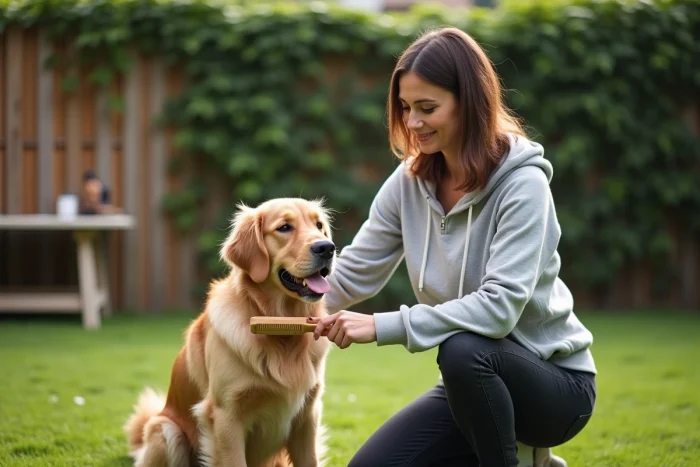
A dull coat, persistent scratching areas, or crusts on the skin often signal an underlying problem: parasites, food allergy, nutritional deficiency. Regular brushing serves both to maintain the coat and to spot these anomalies. On a long-haired dog, untreated knots can hide skin lesions for weeks.

Mouth, eyes, and ears
The dog’s teeth accumulate tartar from the age of two or three years in most breeds. An unusually strong breath, red gums, or a sudden refusal to chew hard toys should raise alarms. Regarding ears, breeds with drooping ears (spaniels, cockers, basset hounds) are particularly prone to ear infections: a strong smell or a dog that shakes its head repeatedly warrants a quick consultation.
The eyes only require gentle cleaning with saline if secretions accumulate in the inner corner. A greenish discharge or a constantly half-closed eye, however, should be evaluated by a veterinarian.
Parasites: seasonal vigilance
Parasite protection is not limited to a pill or a pipette applied on a fixed date. The effectiveness depends on the product used, the exact weight of the animal, and the local parasite pressure, which varies by season and region.
- Ticks are active as soon as the temperature rises a few degrees above zero, extending the risk period in regions with mild climates
- Fleas reproduce year-round in heated interiors: treating the dog without treating the environment (bed, carpets, baseboards) is like emptying a bathtub without turning off the tap
- Intestinal worms require regular treatment, the frequency of which depends on the animal’s lifestyle (access to a garden, contact with other dogs, ingestion of prey)
Physical activity and mental stimulation according to the dog’s profile
A twenty-minute walk on the same sidewalk does not meet the physical or cognitive needs of most dogs. Varying routes stimulates the sense of smell, the dominant sense in dogs, and reduces boredom behaviors at home (destruction, barking, compulsive licking).
Mental stimulation comes from simple exercises: hiding treats in a sniffing mat, practicing a few minutes of positive training before meals, offering a toy dispenser instead of a classic bowl. These activities tire the animal cognitively as much as a long walk, making them particularly useful on bad weather days or for recovering dogs.
A working dog (herder, retriever, malinois) and a companion dog (bichon, pug) do not have the same fatigue thresholds or expenditure needs. Adapting the intensity to the profile of your animal prevents both chronic under-stimulation and a dog that is constantly overexcited because it has been accustomed to a too-high level of activity.
The last point to keep in mind is rest. An adult dog sleeps on average between twelve and fourteen hours a day. Respecting these sleep periods, without constantly demanding attention from the animal, is an integral part of balanced daily care.