
How to Determine the Ideal Size of Land to Park a Motorhome Comfortably
The question of the space needed to park a motorhome is not limited to the length of the vehicle. Between the overall dimensions, the equipment that extends beyond the chassis, and the space required for maneuvering, a plot that seems sufficient on a plan can turn out to be impractical once on site. Field feedback varies on this point, as usage differs significantly from one owner to another.
Access geometry to the plot: the factor that dimensions alone do not show
A plot may have a generous area while remaining unusable. The problem rarely lies in the total area, but in the configuration of the entrance and access path.
The turning radius of a standard motorhome far exceeds that of a car. If the gate requires a tight turn or if the opening width leaves only a few centimeters of margin on each side, aligning the vehicle becomes a stressful precision exercise. The width of the gate and the turning radius matter as much as the area.
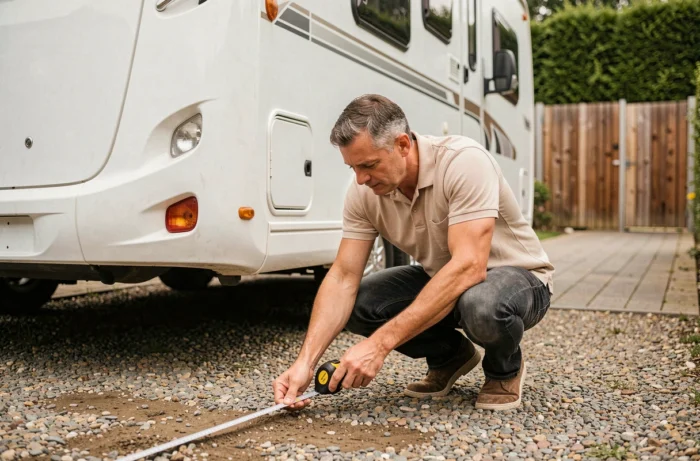
Before measuring the plot itself, it is necessary to separately note the width of the gate, the clearance height (branches, garage awning, cables), and the approach angle from the access road. A gate that is too narrow or a right-angle turn at the entrance is enough to make a properly sized spot inaccessible. To better understand the standard size for a motorhome plot, these access parameters must be included in the calculation from the start.
Motorhome parking space: beyond the overall dimensions
The space occupied by the vehicle alone does not correspond to the space needed to use it. Several elements increase the actual footprint and must be taken into account from the design of the spot.
What extends beyond the chassis
A parked motorhome is not a fixed rectangular prism. Several elements increase its actual footprint:
- The rear bike rack adds a significant depth, sometimes comparable to the length of an adult bike, and prevents the vehicle from being placed against a wall or hedge.
- The opening of the living area door (on the right side for most European models) requires sufficient lateral clearance to enter and exit without constraint, including with luggage or equipment.
- The retractable step, once deployed, widens the footprint on the access side and can hinder a tight spot.
- The garage compartment, accessible via a side or rear door, requires space to load or unload bulky equipment.
All these elements imply that a plot whose dimensions exactly match the vehicle’s size will, in practice, be too small.
The outdoor living space changes the game
Installing an awning, a table, and chairs transforms the very nature of the plot’s occupation. The addition of an awning or furniture can shift parking towards camping, which falls under a different regulatory framework. On private land, this distinction has concrete legal consequences. On public land, it may lead to fines.
For a comfortable stay with outdoor living space, the usable area must therefore include a clear zone of at least the width of the awning, in addition to the vehicle’s footprint and maneuvering clearances.
Local regulations and parking duration: the invisible constraints of the plot
The ideal size of a plot also depends on what the regulations allow. On public roads, uninterrupted parking in the same spot is considered abusive beyond seven days. A municipal decree can reduce this duration, and some municipalities impose specific restrictions on recreational vehicles, including height or length limitations on certain roads.
On private land, the situation is different but not without rules. A motorhome parked permanently on a plot may, depending on the case, require prior declaration. Field feedback varies on municipal practices: some town halls tolerate extended wintering, while others strictly enforce regulations.
Distinction between parking and camping on private land
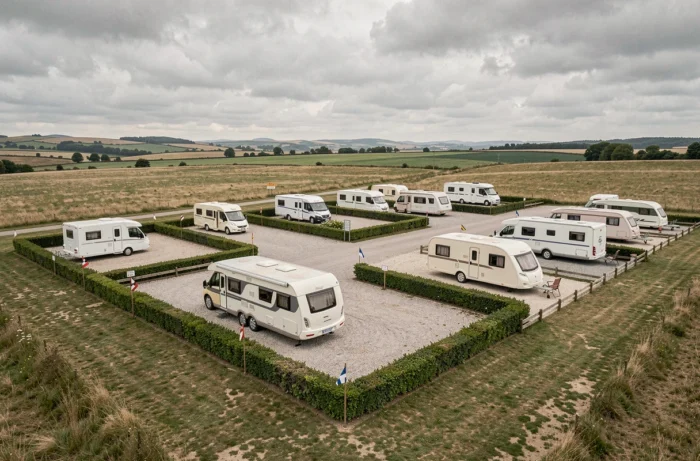
As long as the motorhome remains on its wheels and no equipment extends beyond, the occupation falls under parking. As soon as blocks, an awning, or furniture are installed, the situation may be requalified as camping. A plot sized only for the vehicle is not sufficient for an extended stay if one wishes to deploy a minimum of outdoor comfort while staying within the rules.
This distinction implies that for a private plot intended to regularly accommodate a motorhome, sufficient space around the vehicle must be planned, not only for comfort but also for regulatory compliance.
Ground, slope, and stabilization: the technical criteria of the plot
A flat plot on paper is not necessarily flat in reality. A slope of a few degrees is enough to make a night in a motorhome uncomfortable, and leveling blocks only compensate for moderate inclines.
The nature of the ground plays a decisive role. A dirt or grass plot can become impractical after a few days of rain. Soil stabilization is a prerequisite to avoid the sinking of a vehicle whose weight often exceeds three tons when loaded. Solutions range from compacted gravel to honeycomb slabs, depending on the budget and frequency of use.
The load-bearing capacity of the ground must be assessed based on the total authorized weight of the vehicle. A heavy motorhome parked for several weeks in the same spot on soft ground will eventually sink, making departure difficult without assistance.
Determining the ideal size of a plot for a motorhome requires thinking in three dimensions (length, width, clearance height) and adding the constraints of actual use: access, maneuvers, deployed equipment, nature of the ground, and local regulatory framework. The available data do not allow for a universal area to be set, as vehicle sizes, stay habits, and municipal rules vary too much. The only reliable constant: systematically plan for more width than the vehicle’s overall dimensions.