Top Luxury Shoes for Men: Brands That Enhance Masculine Elegance
A luxury men’s shoe is primarily defined by its manufacturing method and the quality of the leather used. The construction (Goodyear welted, Blake stitched, Norwegian stitched) determines the longevity of the pair, its ability to be resoled, and the comfort it provides after breaking in. Understanding these fundamentals allows one to distinguish a truly high-end shoe from a simply expensive product.
Welted construction and full-grain leather: what separates luxury from premium
The first technical criterion of a luxury shoe remains the type of stitching that connects the upper to the sole. The Goodyear welted construction uses a welt, a strip of leather stitched between the upper and the outsole. This construction allows for several resolings during the shoe’s life, significantly extending its usable lifespan.
The Blake stitch, more flexible and finer, offers a more elegant silhouette but supports fewer resolings. Italian shoemakers favor it for loafers and lightweight shoes intended for warm seasons.
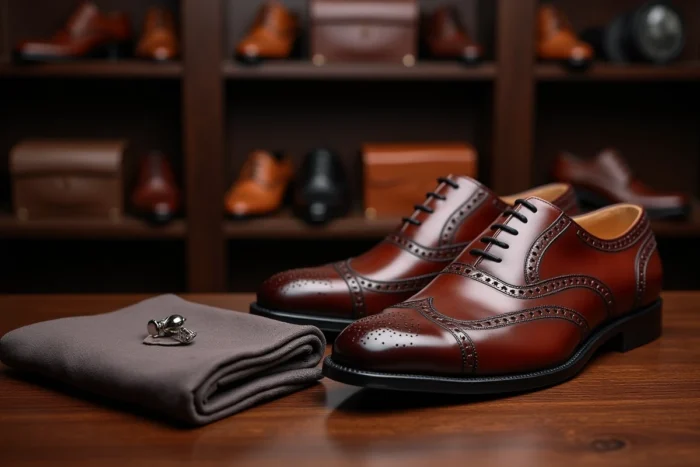
Full-grain leather, un-sanded on the surface, retains the natural grain of the hide. It develops a patina over time rather than degrading, provided it receives regular maintenance. A corrected or resin-coated leather, even sold at a high price, will never age in the same way. When considering luxury men’s shoes, this distinction between full-grain leather and corrected leather serves as the first reliable selection filter.
Quiet luxury applied to shoes: brands with minimal branding
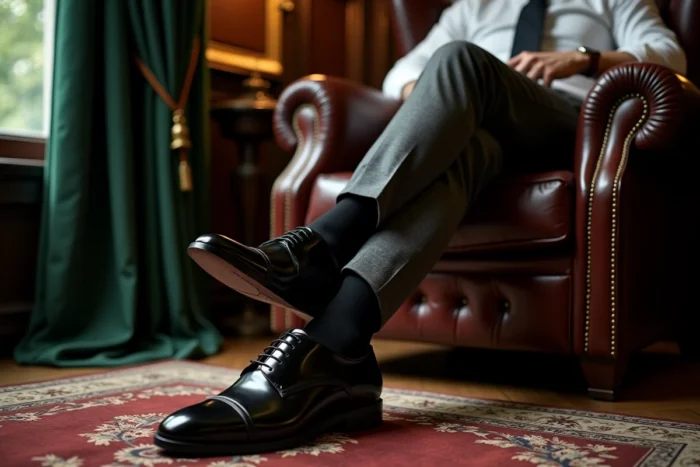
Since 2023-2024, the trend of quiet luxury has profoundly changed expectations regarding men’s dress shoes. Demand is shifting towards houses with minimal branding, where the logo is almost invisible and the lines remain understated.
High-end multi-brand boutiques now emphasize the quality of the leather, the type of construction, and the artisanal roots more than the name printed on the sole. This evolution favors discreet shoemakers, often rooted in strong regional traditions (Northampton in England, the Riviera del Brenta in Italy, Parisian workshops), to the detriment of heavily branded houses.
Three markers help identify an authentic quiet luxury shoe:
- The absence of a visible logo on the upper and outsole, with the shoemaker’s name appearing only on the insole or heel
- A limited color palette (black, brown, cognac, burgundy) and hand-polished finishes rather than uniform industrial shades
- A documented artisanal construction by the brand, explicitly mentioning the type of stitching and the origin of the leather
This discreet approach corresponds to a clientele that prioritizes the construction of the shoe over its social visibility.
Comfort and technologies integrated into luxury dress shoes
One of the least addressed angles in usual rankings concerns the hybridization between luxury and orthopedic comfort. More and more men refuse to compromise between a dressed aesthetic and a rigid sole worn for eight hours a day.
Brands historically positioned on comfort, such as Mephisto with its Soft-Air technology, now offer comfort sneakers that can be worn with a suit. The principle relies on shock-absorbing soles and carefully designed shanks that support the arch of the foot without adding bulk to the shoe’s silhouette.
This trend also affects classic shoemakers. Some integrate memory foam insoles under the inner leather, invisible but noticeable from the first step. The result: a derby or oxford that retains its elegant proportions while absorbing the shocks of daily walking.
Selection criteria for a pair of luxury men’s shoes
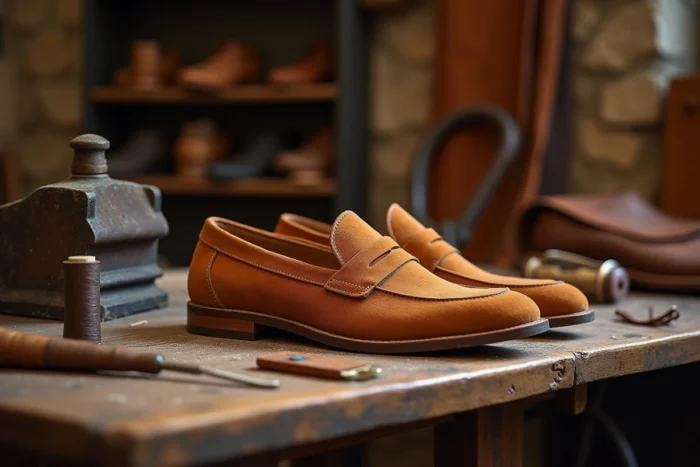
Before investing in a pair, a few technical checks can help avoid costly mistakes. Price alone guarantees nothing about the actual quality of the product.
- Check the type of construction: a Goodyear or Blake stitch will always be mentioned by a serious manufacturer, while industrial gluing will be omitted from the product sheet
- Observe the leather in the light: a full-grain leather shows slight natural irregularities, indicating that the surface has not been sanded or coated with a plastic finish
- Inspect the finishing of the sole edges: artisanal work is recognized by regular, polished edges, sometimes hand-painted, whereas an industrial shoe presents raw or simply dyed edges
- Test the flexibility of the sole: a Blake stitch naturally bends under the foot, while a new Goodyear stitch remains firmer but softens after a few weeks of wear
Maintenance and longevity
A well-maintained luxury shoe lasts for years. Maintenance relies on three simple gestures: cedar shoe trees after each wear to absorb moisture and maintain shape, nourishing polish once or twice a month, and rotating between several pairs to allow the leather to rest for at least twenty-four hours between uses.
Resoling is possible two to three times on a Goodyear stitch, which transforms an initial purchase into a long-term investment. A glued shoe, even expensive, will end up in the trash when the sole comes unglued.
The luxury men’s shoe market is refocusing on craftsmanship, leather, and construction. The brands that stand out are those that document their production process and let the quality of the shoe speak for itself instead of a logo. Choosing a pair based on these technical criteria remains the most reliable method to avoid disappointments, regardless of the budget involved.