
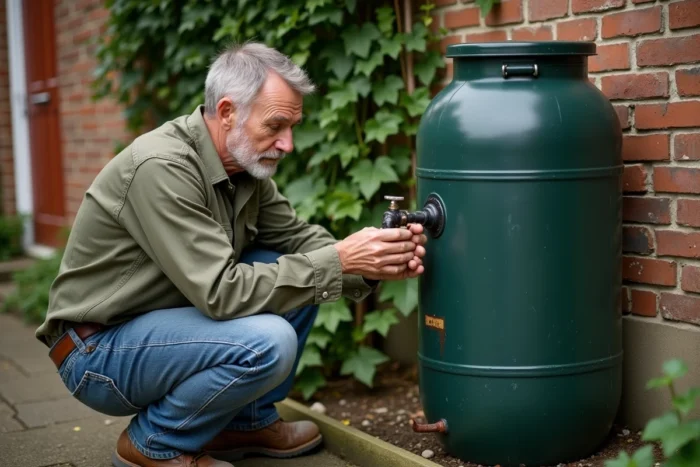
Common Issues with Water Harvesters: Causes, Diagnostics, and Practical Solutions
A rainwater collector that doesn’t fill up, a pump that refuses to restart after a storm, water that turns brown in a few weeks: these malfunctions rarely share a single cause. We observe in the field that most breakdowns result from a chain of neglect upstream of the tank, not from a defect in the tank itself.
Pump Priming Issues and Resetting on Water Collectors
A surface pump or booster associated with a collector does not always restart after a power cut or the triggering of a thermal protection. Before considering a replacement, a simple reset is sufficient in most cases. The pressure switch cuts off the power when the pressure drops below the low threshold, and the pump remains in safety mode until it is manually reset.
The diagnosis begins with checking the fault indicator on the control box. If the pump is equipped with a dry-run protection device, we recommend checking the water level in the tank before any manipulation. A float stuck in the low position keeps the safety active even when the tank is full.
When the pump runs but does not build pressure, the problem almost always lies in the suction circuit. A loose connection or a cracked foot valve allows air to enter, preventing priming. To identify the air intake, we stop the pump, manually fill the pump body through the filling cap, and then restart. If the pressure returns for a few seconds before dropping, the leak is confirmed on the suction line.
By detailing the common problems of water collectors, we find that priming issues are the most frequently confused with material breakage.
Faulty Collection: Gutters, Filter, and Collector
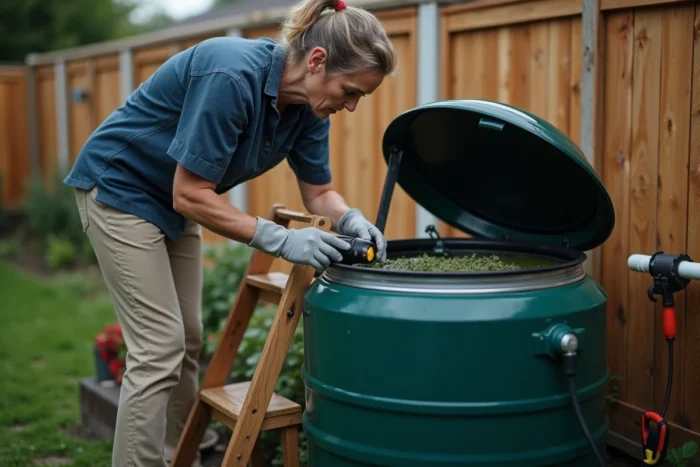
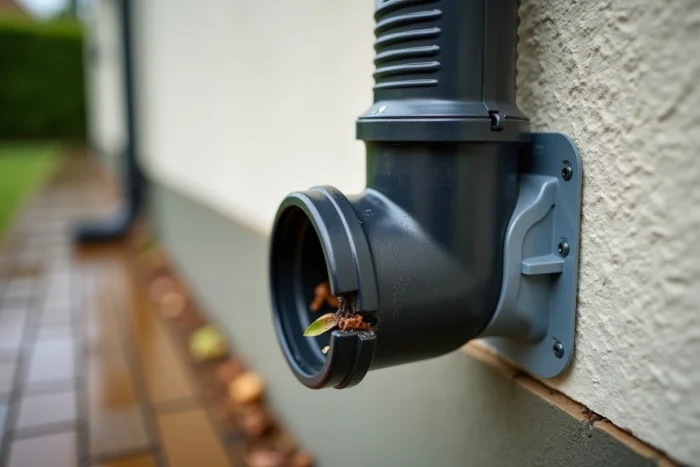
The collector is not filling up, and the tank is not to blame. The upstream collection circuit concentrates the majority of blockages. A downspout filter clogged with leaves, pine needles, or roofing sand reduces the flow to the point of diverting all the water to the gutter overflow.
The collector to be installed on the downspout has a grid or mesh that varies according to manufacturers. A mesh that is too fine retains more debris and requires monthly cleaning during the leaf fall season. A mesh that is too coarse allows particles to pass through that settle at the bottom of the tank and accelerate the degradation of water quality.
Control Points on the Collection Circuit
- Check that the collector is positioned at the correct level on the downspout: too high, it only captures heavy rains; too low, it sucks in the first liters laden with roofing dust.
- Inspect the seals between the collector and the gutter. A seal hardened by UV loses its watertightness in two to three seasons and causes water to flow along the facade rather than into the tank.
- Check for the absence of back-slope on the connecting pipe between the collector and the tank. Even a slight reversed slope is enough to create a stagnant water pocket that blocks the flow.
- Ensure that the overflow of the collector is connected and not obstructed, to avoid pressurizing the circuit that pushes water back into the gutter.
Green Water, Odors, and Deposits: Quality Diagnosis in the Tank
The proliferation of algae in a collector almost always results from exposure to light. Translucent or semi-opaque polyethylene tanks allow enough radiation to trigger photosynthesis. Opaquing the tank with a cover or replacing it with a tinted model solves the problem without chemical treatment.
Bad odors (rotten egg, damp earth) signal anaerobic decomposition of organic matter at the bottom of the tank. Leaves, pollen, and moss debris that pass through the collection filter accumulate and ferment in the absence of oxygen. An annual cleaning of the tank bottom, ideally at the end of winter before the collection season, limits this phenomenon.
Roof Contamination
French regulations remind us that collected rainwater is gathered from inaccessible surfaces and may contain chemical pollutants (pesticides, metals, asbestos fibers depending on the type of roofing). This point is often overlooked during quality diagnosis. An old fiber-cement roof effectively prohibits the use of collected water for any permitted indoor use (sanitary, floor washing).
We recommend systematically purging the first liters after a long dry period. This first water concentrates the particles deposited on the roof. Collectors equipped with a “first flush” system (automatic diversion of the first liters) reduce this load without manual intervention.
Deformation and Watertightness of Above-Ground Polyethylene Tanks
Large volume above-ground collectors (starting from a few hundred liters) undergo underestimated mechanical stresses. A soft or uneven ground causes a gradual tipping of the tank under load. The deformation of the bottom changes the low point, making complete drainage impossible and promoting residual stagnation.
Polyethylene exposed to UV deteriorates on the surface over several years. The micro-cracks that appear on the wall exposed to the south do not leak immediately, but they compromise structural integrity. A tank whose wall sounds hollow when tapped (dull rather than resonant sound) is nearing the end of its life.
For installations connected to a pressurized irrigation circuit, the fitting at the bottom of the tank remains the weak point. The molded thread in the polyethylene deforms under tightening-loosening cycles. A new EPDM seal with each reassembly and hand-tightening (not with a wrench) prolongs the watertightness of this connection.
Replacing an above-ground collector remains an accessible operation, provided that a perfectly horizontal slab or compacted sand bed is prepared before the installation of the new tank.