
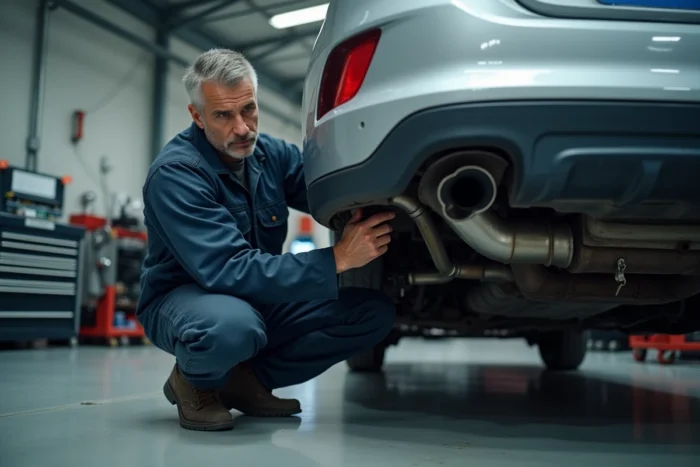
Why Your Exhaust Is Noisy: Common Causes and Effective Solutions
A low rumble at startup, a metallic clank when rolling over a speed bump, a high-pitched whistle when you accelerate: a noisy exhaust can take many forms. Each type of sound points to a specific area of the exhaust system. Identifying that area is already half the battle.
Decoding the type of noise to locate the fault in the exhaust system
Before going under the vehicle, listen carefully. The noise tells you more than a quick visual diagnosis.
A deep rumble that has become very loud often indicates a punctured or cracked muffler. The muffler, located at the end of the line, absorbs the sound waves produced by the engine. As soon as it has a hole, even a small one, the sound escapes without filtering.
A sharp and regular clanking, especially when cold, usually comes from the manifold or the mounts. The metal supports that hold the exhaust line under the chassis corrode over time. When one of them fails, the pipe vibrates against the body and produces a characteristic metallic noise.
A high-pitched whistle during acceleration usually points to a leak at a joint, often between the manifold and the rest of the system. Exhaust gases, under pressure, find the slightest breach and generate this shrill sound. To better understand the causes of car exhaust noise, distinguishing between these three sounds serves as a reliable first filter.
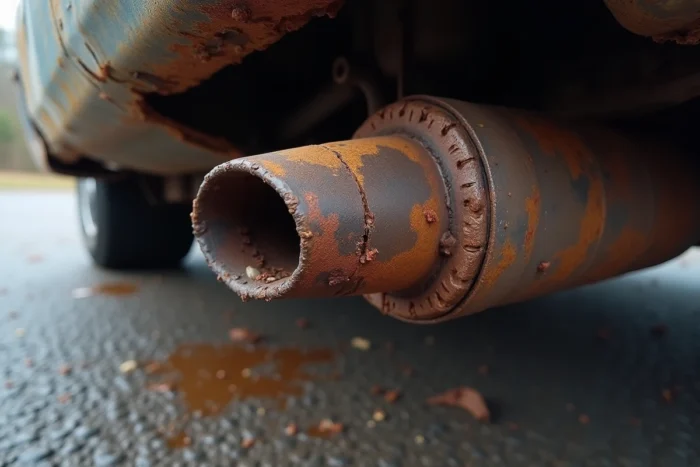
Corrosion, catalyst, and DPF: faults that change the sound of the engine
Have you ever noticed that a vehicle parked by the sea rusts faster? The exhaust line suffers the same fate. Humidity, road salt, and heating-cooling cycles accelerate corrosion from the inside out.
Catalyst wear
The catalyst transforms polluting gases into less harmful compounds using precious materials deposited on a ceramic honeycomb. When this internal structure degrades, fragments vibrate inside the casing. The result: a metallic rattling noise audible at idle.
A damaged catalyst not only makes noise. It also causes a loss of power, increased fuel consumption, and excessive pollutant emissions. The technical inspection will penalize this defect.
Clogging of the particulate filter
The DPF traps soot particles produced by diesel engines (and some recent gasoline engines). Advanced clogging alters the back pressure throughout the exhaust line. The engine “breathes” more difficultly, and the sound becomes rough, sometimes accompanied by unusual vibrations.
A clogged DPF forces the engine to work under strain, which can trigger a check engine light and cause the system to overheat. Regular highway driving allows the DPF to regenerate naturally, but professional cleaning is sometimes necessary.
Noisy exhaust and technical inspection: what you really risk
A noisy exhaust is not just an auditory annoyance. It is also a regulatory issue that can be costly.
During the technical inspection, any detected exhaust leak results in a re-inspection. The inspector checks the tightness of the line, the condition of the catalyst, the noise level, and pollutant emissions. A punctured muffler or a broken catalyst will systematically lead to a refusal.
The legal aspect goes further. A vehicle whose exhaust produces excessive noise on public roads exposes its owner to a fine. Law enforcement may also immobilize the vehicle until it is brought into compliance.
The issue even extends beyond the road. A very noisy exhaust regularly used in a residential area can be classified as an abnormal neighborhood disturbance. Neighbors then have recourse: mediation, a bailiff’s report, and as a last resort, legal action to obtain cessation of the nuisance and damages.

Repair or replace: concrete solutions depending on the affected part
Not all repairs are equal. The choice depends on the faulty part and the extent of the damage.
- Cracked exhaust gasket: replacing a gasket between the manifold and the pipe remains a low-cost intervention. The part itself is inexpensive, and labor typically takes less than an hour in most cases.
- Punctured muffler: a small hole can be temporarily sealed with a high-temperature exhaust paste or bandage. This solution lasts a few months. For a heavily corroded muffler, complete replacement remains the only sustainable option.
- Broken mounting support: the rubber mounts (exhaust suspension bushings) are easily and cheaply replaced. Ignoring this fault accelerates wear on other components due to vibration.
- Faulty catalyst or DPF: these parts represent the most expensive intervention. Their replacement requires precise diagnosis, as a check engine light may indicate a simple sensor issue rather than a part that needs changing.
A tip to assess urgency: run your hand (engine cold) along the exhaust line looking for areas of flaky rust, visible holes, or hanging supports. A visual inspection from underneath the vehicle, on flat ground, often reveals the source of the noise without any tools.
Preventive maintenance of the exhaust: what really extends its lifespan
Avoiding repeated short trips is the most effective preventive measure. Short trips prevent the system from reaching its operating temperature, which encourages internal condensation and accelerates corrosion.
Having the exhaust line checked during each service allows for spotting a worn mount or the beginning of a crack before they become noisy. A mechanic equipped with a lift can identify in minutes what escapes a visual inspection on the ground.
Replacing a bushing in time prevents having to replace an entire muffler a few months later. Prevention on the exhaust works exactly like elsewhere in mechanics: small regular interventions cost much less than large late repairs.
A noisy exhaust always tells something specific. Locating the sound, identifying the affected part, and acting before the technical inspection or a neighbor’s complaint remains the best approach, both for your wallet and for your peace of mind.