
Everything You Need to Know About the Guardrail Standards Regulations in Effect in 2025
The NF P 01-012 standard, the reference text for the design of guardrails in France, had not changed since 1988. Its revision, published on November 22, 2024, profoundly modifies the technical requirements applicable to new projects. Understanding what changes concretely for projects submitted in 2025 requires distinguishing the regulatory timeline, geometric evolutions, and the gray areas that professionals discover during the first inspections.
Guardrail standard and regulation: a costly confusion
A point rarely explained in articles aimed at the general public: the NF P 01-012 standard is not a legal text. It is a voluntary standard, published by AFNOR, that construction professionals apply because it constitutes the technical reference recognized by insurers and control offices.
This nuance has direct consequences. A project owner who installs a guardrail that does not comply with the standard does not strictly violate an article of the Construction Code. However, their civil and ten-year liability remains engaged if the device does not fulfill its function of protection against falls. Courts rely on the standard as a technical reference to assess compliance.
This distinction explains why some manufacturers present their products as “designed in compliance with current standards” without ever stating “compliant with the law.” To delve deeper into the regulation of guardrail standards and its practical implications, the topic deserves attention before launching a project.
Application timeline of the NF P 01-012 version 2024
The 2024 version does not apply overnight to all projects. The determining criterion is the date of submission of the building permit or prior declaration of work, not the date of signing the contract or the start of work.
- Building permits and prior declarations submitted from June 1, 2025, fall under the 2024 version of the standard.
- For submissions prior to June 1, 2025, the 1988 version remains applicable to the resulting work contracts.
- Works not subject to urban planning authorization will transition to the new version on January 1, 2026, based on the date of contract award.
This “date of submission” mechanism creates a concrete situation: a project designed entirely according to the old standard but for which the permit is submitted after June 1, 2025, must be brought into compliance with the 2024 version. Feedback from control offices confirms that this rule is strictly enforced, without exceptions related to the progress of the design.

Protection height and support zone: the two major technical modifications
The 2024 version of the standard expands the area in which the presence of supports that could allow climbing over a guardrail is sought. Until now, this area extended up to 0.45 m above the activity zone. It now increases to 0.60 m.
This modification was motivated by recurring observations of falls involving children. Behavioral studies show that young children can use elements located higher than the previous limit to climb over the guardrail.
Supports on the guardrail and in its environment
The standard distinguishes three configurations of support that must be verified during the design:
- The support located directly on the protective element (horizontal bars, intermediate rails, decorative elements).
- The support in the interior environment of the guardrail (fixed furniture, integrated planters, adjacent low walls).
- The support in the external environment accessible through the protective element, such as a facade ledge reachable between the bars.
With the elevation of the search area to 0.60 m, configurations that were previously compliant become non-compliant without any physical element of the guardrail having changed. A simple low wall or an integrated planter nearby may be enough to invalidate the installation.
Risk of passing through
The 2024 version also strengthens the requirements regarding passing through the protective element. The spacing between bars, the dimensions of openings in infill panels (glass, perforated sheet, cables) are recalibrated to limit the risk of a child being able to slip through or get a part of their body stuck.
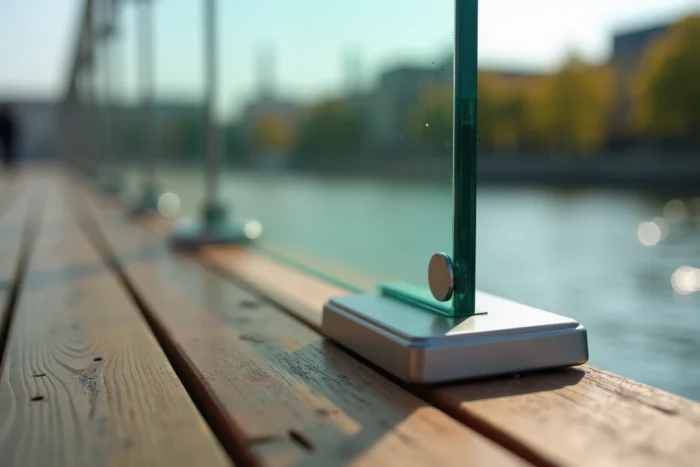
For glass guardrails, the standard specifies the criteria for impact resistance and retention in place after breakage. The safety of the infill is no longer limited to the strength of the panel: the fixation and post-break behavior are now evaluated.
Expanded scope: beyond balconies and stairs
One of the least commented changes concerns the expansion of the scope of the standard. The 1988 version focused on well-identified typologies: stair railings, balcony guardrails, terrace protections, window sills.
The 2024 version thinks differently. Compliance is measured by the function of protection against falls, regardless of the location: accessible roofs, bleachers, skylights, technical walkways. This functional shift requires the authors of the CCTP to rethink how they specify protections. A ground-level terrace guardrail and a peripheral protection for an accessible roof terrace fall under the same normative framework, with height and resistance requirements adapted to the use.
Existing buildings and limits of the 2025 standard
The revised standard targets new constructions and projects subject to urban planning authorization. For the existing stock, the situation remains ambiguous. No obligation for retroactive compliance is provided by the text. A guardrail installed in the 1990s, compliant with the 1988 version, does not have to be replaced solely due to the publication of the new standard.
Field feedback varies on this point when it comes to partial renovations. If a co-owner replaces a balcony guardrail as part of a renovation subject to a prior declaration submitted after June 2025, does the 2024 version apply to this guardrail alone or to the entire facade? The available data does not allow for a uniform conclusion, and control offices adopt varying positions depending on the regions.
The 1988 version of the standard will be officially repealed in January 2026. After this date, only the 2024 version will serve as the technical reference for judicial expertise and insurance assessments. Professionals who delay integrating the new requirements into their design practices expose themselves to compliance gaps that are difficult to correct once the project is delivered.