
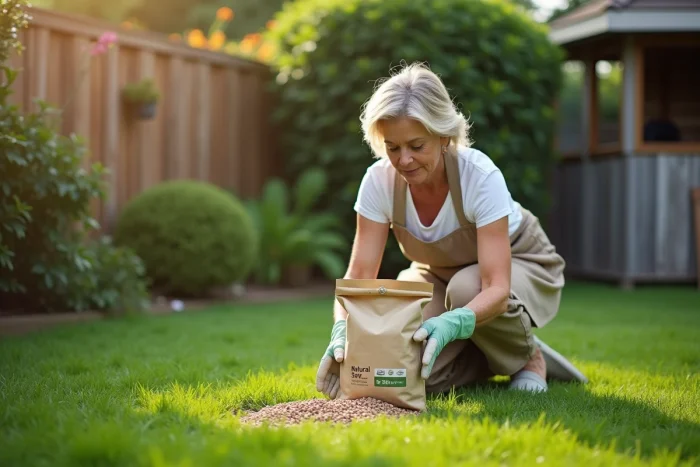
How to Choose an Effective and Eco-Friendly Natural Lawn Fertilizer
A yellowed or sparse lawn does not necessarily lack fertilizer. Often, the soil itself is the problem: too acidic, too compact, or depleted of organic matter. Choosing a natural fertilizer for grass without first understanding what is happening beneath the surface is like treating a symptom without addressing the cause. The goal here is to establish the right criteria for selection before opening any bag.
Correct the soil before fertilizing the lawn
Have you ever noticed that a lawn can remain dull despite regular applications of fertilizer? The problem often stems from soil whose pH or structure prevents the roots from absorbing nutrients.
Landscapers and green space managers repeat: correcting the pH and structure of the soil before any fertilizer application helps to reduce the necessary doses later on. A liming amendment on acidic soil, or the addition of mature compost on clayey and compact soil, changes the game much more than fertilizer alone.
In practical terms, corrected soil retains water better, allows air circulation, and promotes biological activity. Microorganisms that decompose organic matter work faster in a balanced environment. The natural fertilizer you add later will be better transformed and better absorbed by the roots.
To know the pH of your soil, a basic analysis kit is sufficient. If the result indicates a very acidic soil, a light liming in the fall prepares the ground. If the soil is sandy and draining, incorporating mature compost on the surface improves its retention capacity. Finding an effective natural fertilizer for grass starts with this often-overlooked step.
Solid organic fertilizer or liquid foliar fertilizer: two different approaches
A solid organic fertilizer in granules and a liquid foliar fertilizer do not serve the same purpose. The former nourishes the soil, while the latter feeds the plant directly through its leaves. Mixing the two in the same basket leads to poor choices.
Organic granules: nourishing the soil over time
Solid organic fertilizers (made from feather meal, ground horn, composted manure) release their nutrients slowly. Soil microorganisms decompose them over the weeks. This gradual release limits the risk of root burn and reduces leaching into groundwater.
On the flip side, the effect is not immediate. A severely deficient lawn will not green up in a few days with solid organic fertilizer. Patience is part of the deal.
Liquid foliar fertilizer: fast and targeted action
Liquid organic foliar fertilizers, often based on plant extracts or animal by-products, are sprayed directly onto the leaves. The absorption is very rapid. The applied doses are much lower and targeted, which reduces the risk of nutrient leaching.
This type of product is well-suited for a quick boost, for example, after winter or following a dry spell. However, it does not replace a foundational soil amendment.
Reading the NPK composition of a natural fertilizer for grass
On every fertilizer package, three numbers indicate the proportions of nitrogen (N), phosphorus (P), and potassium (K). Why do these three letters matter so much?
- Nitrogen (N) stimulates leaf growth and gives that dense green color. An excess of nitrogen makes the lawn thirsty and more vulnerable to diseases.
- Phosphorus (P) promotes root development. It is useful at the time of seeding or overseeding, less necessary on a well-established lawn.
- Potassium (K) strengthens resistance to cold, drought, and foot traffic. It is an ally for lawns under stress in summer or fall.
A so-called “balanced” fertilizer displays NPK values that are close to each other. Choosing an NPK ratio suitable for the season and the state of the lawn avoids wasting money and overloading the soil with unnecessary elements.
In spring, a fertilizer richer in nitrogen kickstarts growth. In fall, prioritize a product with more potassium to prepare the lawn for winter. This seasonal alternation makes all the difference over an annual cycle.
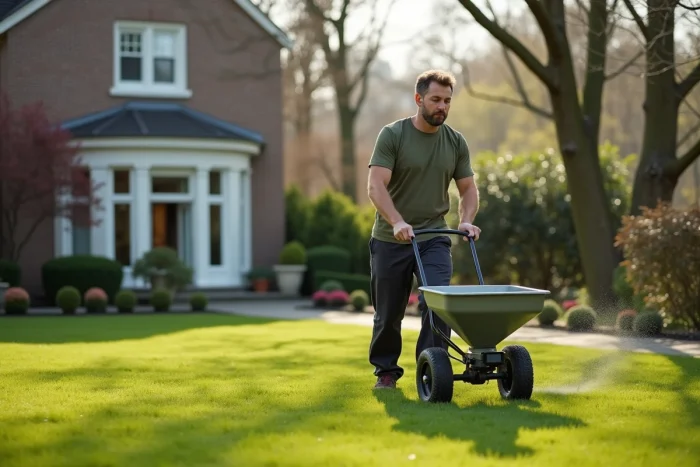
Alternatives to fertilizer: high mowing, mulching, and spaced watering
Natural fertilizer is not the only answer for a healthy lawn. Several maintenance practices reduce the need for fertilization, sometimes significantly.
- High mowing (leaving the grass at a more generous height) encourages deep rooting. Longer blades shade the soil, limit evaporation, and slow the growth of weeds.
- Mulching, which involves leaving finely chopped mowing residues in place, directly returns nitrogen and organic matter to the soil. It is a free and immediate fertilizer produced with every mowing.
- Spaced but deep watering encourages roots to seek water deeper down, making the lawn more self-sufficient and more resistant to dry periods.
This combined approach is now presented as a credible alternative to regular fertilization, even by lawn care professionals. On already corrected and living soil, these practices can be sufficient to maintain a dense lawn without any external input.
Sensitive areas and natural fertilizers: the limits to know
A fertilizer labeled “natural” or “organic” is not without impact on the environment. Public environmental agencies in France have been recommending for several years to reduce all fertilizer applications, including organic ones, near watercourses and groundwater.
On very draining soil (sandy, for example), even an organic fertilizer can contribute to nitrogen leaching. On sloped land near a stream, runoff carries some nutrients into the aquatic environment, promoting eutrophication.
Public recommendations encourage indirect fertilization solutions in these cases: green manures, mulching, or simply reducing the grassed area in favor of less demanding ground covers. Less lawn to maintain means less fertilizer to spread, regardless of their origin.
The best natural fertilizer for grass is one whose dose is calibrated to the strict necessary, after correcting the soil and adopting good mowing and watering practices. In some contexts, the most ecological answer remains to not fertilize at all.