
Organic Gardening: Best Practices for a Healthy, Productive Vegetable Garden
Organic vegetable gardening is based on a set of growing practices that avoid synthetic chemicals. In France, increasingly frequent droughts and stricter watering rules are changing the landscape for home gardeners. Growing a healthy, productive vegetable garden is no longer just about choosing seeds or compost: water management, governed by local prefectural orders that vary from one area to another, is now part of the equation.
Organic vegetable gardens and watering restrictions: what the regulations say
Watering your vegetable garden with mains water is not an automatic right during a drought. Prefectures issue orders that may limit or even prohibit watering vegetable gardens, depending on the severity of the situation. To find out which rules apply to a specific address, VigiEau lets you check the current restrictions in your municipality.
Having a rainwater collection tank does not exempt you from complying with these restrictions. Prefectural orders may apply to all water sources, including stored rainwater. The common belief that a collection tank gives you complete freedom to water does not hold up when you read the local regulations.
Since September 1, 2024, the July 12, 2024 order has replaced the August 21, 2008 order governing domestic uses of rainwater. Rainwater collected from rooftops can be used to water a vegetable garden, but it is not considered potable. Its quality depends on the roofing material, the condition of the gutters, and storage conditions. The resources available on jardinage-bio.com cover several watering techniques suited to these constraints.
One regulatory distinction is worth noting. A tank used solely to water an outdoor garden does not require the same procedures as a system connected to the home. A declaration to the town hall is required for certain indoor uses. Administrative requirements therefore depend on the intended use, not just on whether a rainwater collector is installed.
Living soil in the vegetable garden: building fertility without chemical fertilizers
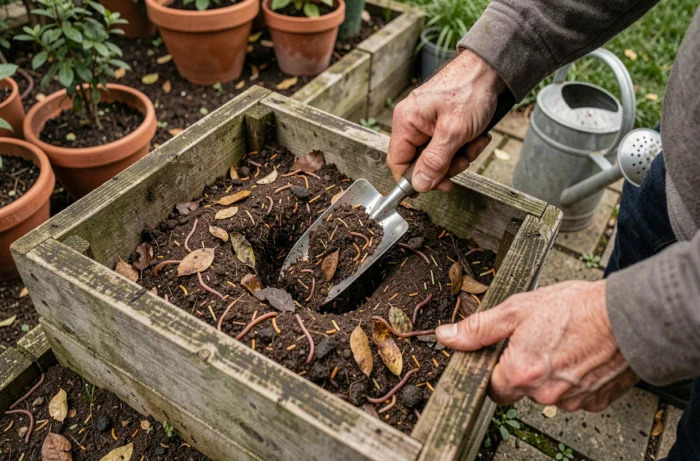
An organic vegetable garden soil functions as an ecosystem. The soil is home to microorganisms, mycorrhizal fungi, and decomposer organisms that turn organic matter into nutrients vegetables can absorb. Feeding this living network rather than the plant directly is the fundamental principle of organic gardening.
Compost and organic soil amendments
Compost remains the go-to soil amendment. It improves soil structure, water retention, and nutrient content. Mature compost is recognizable by its woodland-floor smell and the absence of identifiable pieces.
It is best applied in autumn or late winter, in a layer a few centimeters thick, lightly worked into the surface. Burying fresh compost too deeply can create anaerobic zones that harm roots.
Mulching and keeping the soil covered
Leaving soil bare between vegetable rows speeds up evaporation and encourages crusting. Organic mulch (straw, hay, shredded branches, fallen leaves) serves several purposes at once:
- It reduces watering needs by retaining soil moisture, a direct advantage when water restrictions are in place
- As it decomposes, it gradually feeds soil life, reducing the need for fertilizers
- It limits weed growth and avoids repeated mechanical weeding that disrupts soil structure
A sufficiently thick layer of mulch cuts evaporation in half compared with bare soil exposed to the sun. When watering is restricted, this is the first way to save water, even before installing a collection tank.
Companion planting and crop rotation in an organic vegetable garden
Growing the same vegetables in the same spot year after year depletes the soil and encourages the buildup of specific pathogens. Rotating crops over three or four years provides free and effective protection against disease.
The principle is to alternate botanical families. Tomatoes (nightshades) should never follow potatoes (which belong to the same family). After a nitrogen-hungry crop, plant legumes (beans, peas, broad beans), which fix atmospheric nitrogen in the soil through their root nodules.
Beneficial plant combinations
Some vegetable garden combinations are more than folklore. Carrots and leeks grown side by side help reduce attacks from each other’s pests (carrot fly and leek moth). Dwarf beans planted at the base of tomato plants fix nitrogen that is available to neighboring roots.
Companion planting works best in narrow beds where plants are close enough to interact. On large plots with widely spaced rows, the protective effect is reduced.
Watering an organic vegetable garden with rainwater: practical precautions
Collected rooftop rainwater is not automatically suitable for every use in the vegetable garden. Current recommendations advise watering at the base of plants rather than spraying the parts that will be eaten. This limits contact between untreated water and leaves or fruit intended to be eaten raw.
Before using rainwater in the vegetable garden, check the following:
- The condition of the roof: some materials (asbestos-cement roofing, copper-treated roofs) contaminate runoff
- The cleanliness of the gutters and the filter upstream of the tank, which determine the quality of the stored water
- Storage time: water left stagnant for several weeks in a poorly ventilated tank can develop bacteria
- The type of vegetables being watered: lettuce and strawberries, which are eaten raw, pose a greater risk than vegetables that are cooked
A gravity-fed drip irrigation system supplied by an elevated tank combines water savings, compliance with restrictions, and food safety. This setup reduces waste and targets the root zone without wetting the foliage.
Organic vegetable gardening relies on a series of technical choices that work together logically: nourished soil retains water better, a thick layer of mulch reduces watering, and a well-maintained rainwater collection system supplements the setup when mains water is restricted. Local water regulations, which can be checked through VigiEau, are now one of the factors to consider from the moment you plan your vegetable garden.