
Which plants to pair with lilies for a harmonious and flourishing garden?
Associating plants with lilies is not just about juxtaposing colors in a flower bed. The choice of companion plants determines the bed’s ability to withstand drought episodes, attract pollinators, and limit maintenance over several seasons. Lilies, with their concentrated summer bloom between June and September, leave a visual void for the rest of the year that must be anticipated from the design stage.
This article compares the main families of companion plants for lilies according to three criteria rarely intersected in gardening guides: drought tolerance, biodiversity interest, and complementary blooming periods.
Comparative table of companion plants for lilies by function
Before choosing associations, one must lay out the data side by side. This table groups the most relevant perennials, grasses, and shrubs to plant with lilies, classified by their main role in the bed.
| Companion Plant | Type | Blooming | Drought Tolerance | Pollinator Interest | Role in the Bed |
|---|---|---|---|---|---|
| Lavender | Bee-friendly perennial | June-August | High | Strong | Ground cover, fragrance, bees |
| Yarrow | Bee-friendly perennial | June-September | High | Strong | Attracts beneficials, contrasting umbels |
| Stipa tenuissima | Ornamental grass | Evergreen foliage | High | Low | Texture, movement, natural mulch |
| Red Valerian | Bee-friendly perennial | May-September | High | Strong | Color, height, butterflies |
| Bronze Fennel | Aromatic perennial | July-August | Medium to high | Strong | Feathery foliage, hoverflies |
| Miscanthus sinensis | Ornamental grass | Autumn spikes | Medium | Low | Vertical structure, winter interest |
| Dahlia | Bulb/tuber | July-October | Low | Medium | Flowering relay, bright colors |
| Catmint | Bee-friendly perennial | May-September | High | Strong | Blue ground cover, long blooming |
The first observation: bee-friendly perennials that are drought-tolerant (lavender, yarrow, valerian, catmint) combine three functions into a single plant. Ornamental grasses, on the other hand, do not attract pollinators but provide a structure that flowering perennials do not offer.
To discover plant associations on zlaticonstructions.fr, aesthetic criteria are detailed variety by variety, complementing this functional grid.

Bee-friendly perennials and lilies: a bed favorable to pollinators
The usual content on lily associations focuses on color harmony, suggesting coordinated pastel tones. The angle of functional biodiversity is rarely addressed. The logic is simple: a bed that nourishes pollinators and beneficial insects (hoverflies, ladybugs) regulates better against aphids, a common pest of lilies.
Lavender and yarrow form a particularly effective duo at the base of lilies. Their blooms cover a wide period, from June to September, which ensures a continuous food resource for bees throughout the lily season.
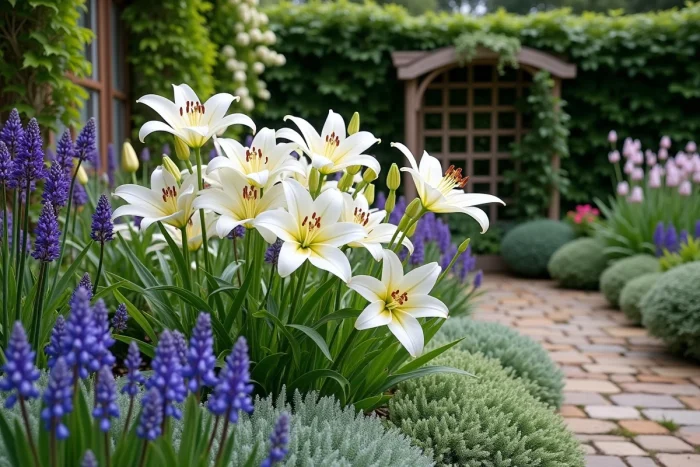
Bronze fennel deserves special attention. Its feathery, coppery foliage creates a striking contrast with the trumpet-shaped flowers of oriental lilies. Its umbels attract hoverflies, whose larvae consume aphids. This association falls under a logic of passive biological control that reduces the need for treatments.
- Red valerian (Centranthus ruber) settles in poor, dry soils, where lilies need proper drainage, making them compatible in terms of soil.
- Catmint (Nepeta x faassenii) forms a blue-purple carpet at the base of lilies, masking bare soil and limiting evaporation while attracting bumblebees and solitary bees.
- Yarrow comes in yellow, red, and pink varieties, allowing adaptation of the color palette to the chosen lily cultivar without sacrificing ecological interest.
Ornamental grasses: structure and resilience against drought
A lily bed without grasses lacks texture between blooms. Asian and oriental lilies have bare vertical stems at their lower part. Grasses fill this area.
Stipa tenuissima (angel hair) remains the most suitable grass for lily beds in dry climates. Its drought tolerance is high, its fine foliage undulates in the wind and creates a texture contrast with the wide petals of the lily. In winter, its dry stems maintain a visual presence when the lily has disappeared underground.
Miscanthus sinensis is better suited for large beds. Its spikes appear in autumn, taking over the visual role after the end of the lily bloom. However, it requires more moisture than stipa and is not suitable for very well-drained soils.
The association of lilies, low grass in the foreground, and tall grass in the back of the bed creates a three-tiered structure that works year-round. This principle of a “garden of absence,” designed to remain beautiful even without regular maintenance, does not appear in most lily planting guides, which presuppose a garden maintained daily.
Contemporary color palette: moving beyond pastel associations
Classic lily associations revolve around soft tones (white, pale pink, lavender blue). More contrasting palettes, however, yield more striking visual results and align with a trend in contemporary gardens.
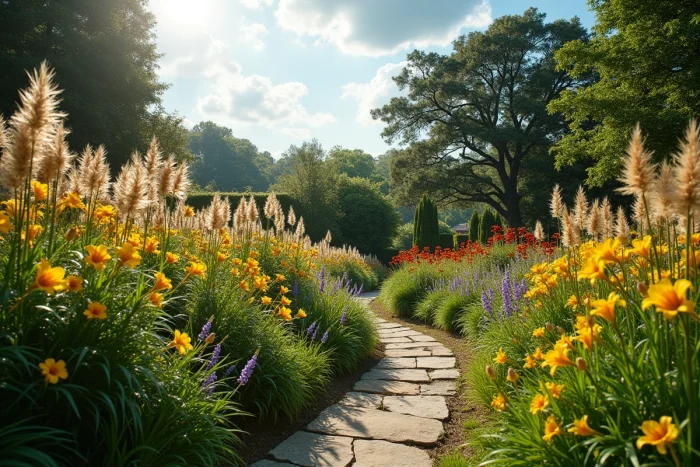
A bright orange Asian lily paired with bronze fennel and blood-red yarrow produces a warm, structured bed. This combination works because all three plants share the same requirements: drained soil, sunny exposure, moderate watering.
Conversely, a white oriental lily planted with blue catmint and golden stipa plays on a more subtle cool-warm contrast. The white of the lily stands out more against blue and golden foliage than against a uniformly pastel bed.
Dahlias, often cited as companions for lilies, pose a consistency problem in dry conditions. Their water needs are significantly higher than those of lilies and the bee-friendly perennials listed above. In a bed designed for climate resilience, dahlias complicate watering management and require compartmentalizing irrigation zones.
The choice between a low-maintenance resilient bed and a water-intensive bed is made as soon as companion plants are selected. Bee-friendly perennials and ornamental grasses tilt the balance toward sustainability, while traditional associations with water-hungry bulbs demand regular monitoring that recent summers make increasingly burdensome.